Pound net
Once thought of as a ‘silver-bullet’ solution to declining wild salmon populations, it is now believed that hatcheries can cause more harm than good. A conservation organisation in the Pacific Northwest is drawing on the past to help create a better future for this vital species.
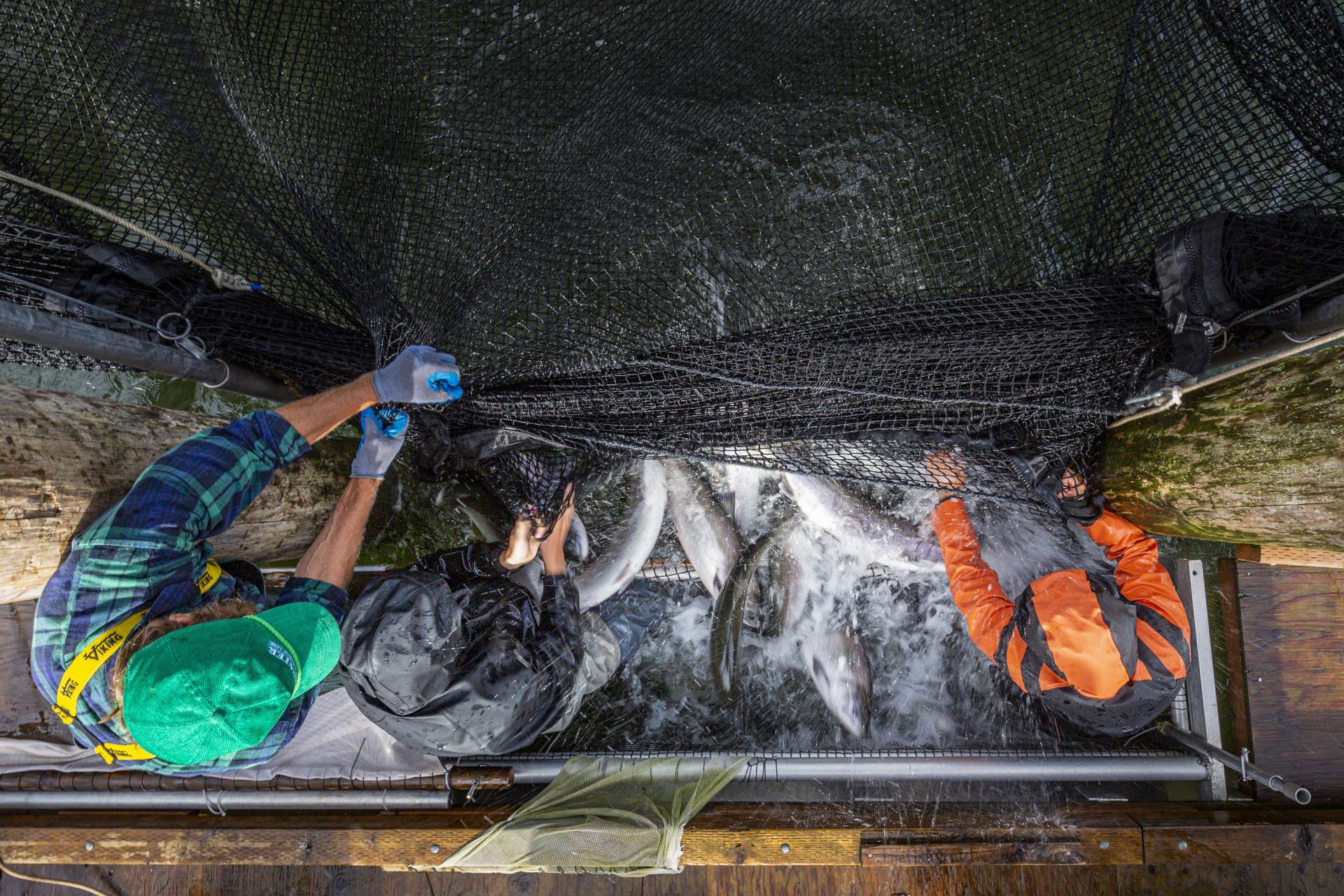
“Wild Coho, adult,” shouts Aaron. The salmon fights him as he carefully moves it from the live-well and releases it back into the river. It’s a sunny autumn afternoon, the air is crisp. “Hatchery, Coho, adult,” he yells again. This salmon’s fate is not as positive as the previous. It wriggles and splashes as he skilfully wrestles it into a large fishing net. It’s swiftly transferred to an industrial-sized blue cooler where its gills are slit and it’s submerged into slush ice. The fish continues to splash momentarily in the icy water as it takes its last few breaths.
I’m down on the Washington State-side of the Columbia River near Cathlamet. I’d heard about an intriguing new type of fishing gear being trialled as a method to aid in the recovery of declining salmon stocks here in the Pacific Northwest. It’s called a Pound Net, and it’s not new at all, and what’s more, it’s currently illegal. This Pound Net is a modernised version of a trap utilised by Indigenous peoples and European settlers of the area many years ago, and it has been outlawed in Washington State for almost 90 years. When European settlers arrived in the Pacific Northwest, they were keen to exploit the region’s natural resources such as gold, animal pelts, timber, and of course salmon. This was during a time when there were no restrictions on which fish or how many could be caught. What’s more, is that there were no laws that protected the environment from being altered and exploited for its resources like the damming of rivers or harvesting timber.
The settlers adopted the Pound Net, and other traps like it, from local Indigenous peoples and altered it to catch as many fish as they could, with some traps hauling in upwards of 40,000 fish in a single take. Local gillnetters were also trying to make a living by fishing for salmon and were in steep competition with the canneries, which owned most of these fish traps along the Columbia River. As this area developed, large swaths of forest were clear-cut for timber, hydroelectric dams were erected to power cities, and more and more fish were harvested and processed through various means to keep up with the ever-increasing demand. This put immense pressure on the environment and wild salmon. When fish stocks began to decline, gillnetters blamed the fish traps for the diminishing salmon populations, and in 1934, fish traps were banned in Oregon and Washington State. However, despite the ban, salmon runs continued to suffer from ongoing pressures from overfishing, dams, and habitat destruction.
Wild salmon were at risk of being lost due to over-exploitation and a thriving fishing industry was soon to follow but no one could pinpoint one glaring issue. What could be done? The answer: Just make more. The implementation of salmon hatcheries in the Pacific Northwest came about in the 1880’s. The goal was quite simple; establishing a hatchery would supplement weak, unstable, or endangered runs and mitigate for habitat destruction. For example, the construction of a dam would knowingly block access to vital upstream spawning habitat for migrating wild salmon, causing a population decline or crash. By establishing a hatchery on this river, you could augment the crashing number of wild salmon by simply rearing more on land and releasing them back into the system. It seemed sensible.


This feature appears in ISSUE 35: BUILDING HOPE of Oceanographic Magazine
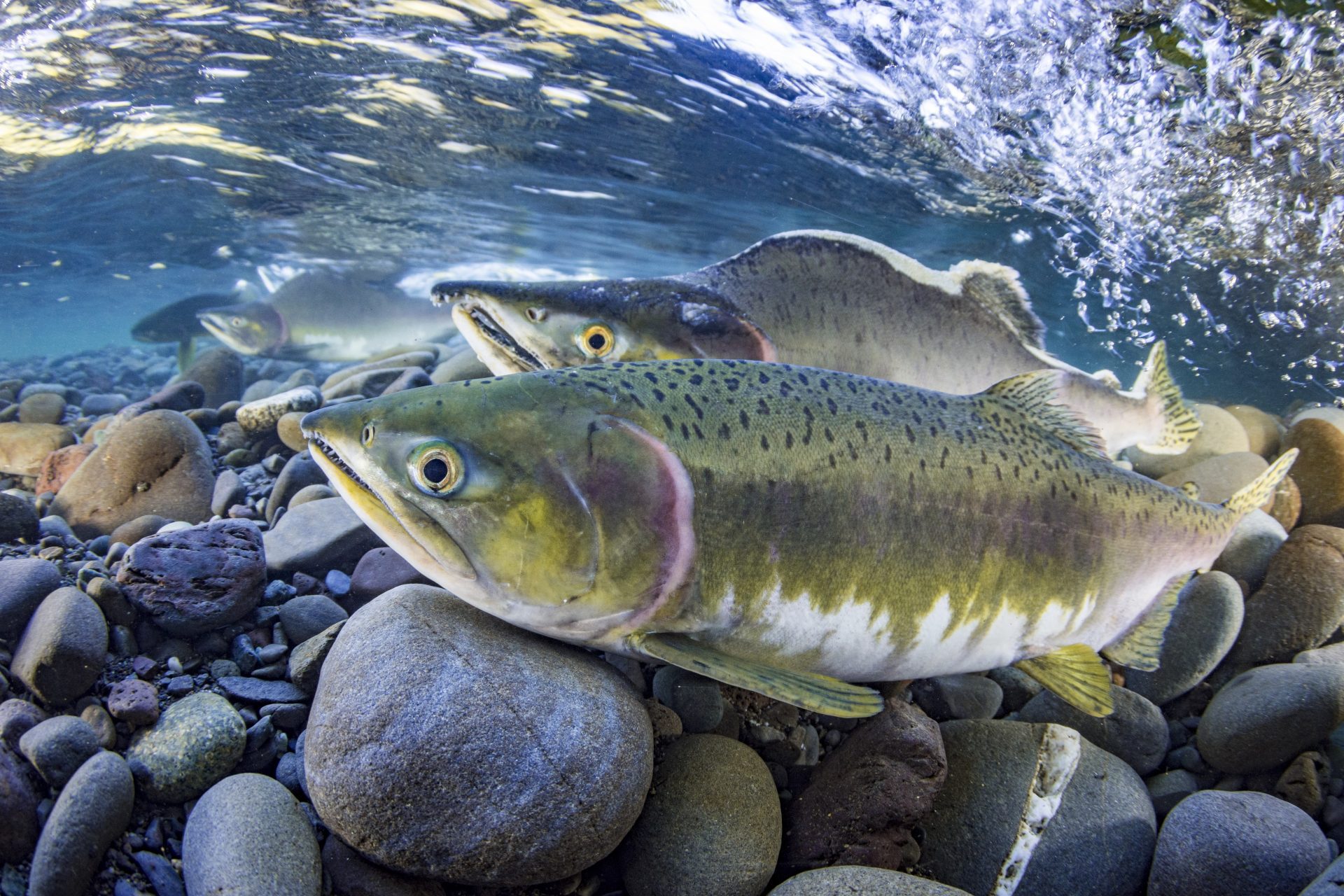
In the wild, salmon imprint on the stream in which they were born. In the winter, the eggs hatch, and salmon emerge from the gravel and begin their arduous life as an alevin – the name given to the life stage of a recently born salmon. From the moment they emerge, they’re vulnerable and must adapt quickly to navigate a hostile world. As they grow through their life stages in the wild, they learn to rely on key instincts for survival. To increase their chances, juvenile salmon will utilise log jams, riverbanks, or small pools with low-hanging foliage for cover in order to evade hungry predators. These protected sections of streams are also ideal places for juvenile salmon to forage for food. In the wild, many salmon will not make it to adulthood due to several contributing factors. Predation is the one, but in certain years, increased rainfall causes flooding which scours the riverbeds and wipes out the new generation of wild salmon. Regardless of the hurdle, survival in the wild as a salmon is not for certain.
Conversely, in a hatchery, juvenile salmon are reared on land by humans, often specifically for human consumption. After the wild broodstock is taken and killed, they’re cut open and their eggs and sperm (milt) are harvested. The females have their eggs removed from their egg sacs and are collected in buckets. The males are squeezed and their milt is collected in small cups or plastic bags. Both the milt and eggs are then mixed and washed in iodoform, a type of antiseptic solution. Once the fertilisation process is complete, the eggs are put into a series of plastic trays where water, diverted from the river, washes over them and they’re left to incubate. Once the salmon hatch and have matured enough, they’re put into long and narrow concrete pools called raceways. Here, they’re fed by hand and protected by netting to ensure their survival until they’re ready to be released out into the wild. The hatchery success rate is much higher than in the wild. As humans control this delicate stage of the salmon’s life, there are no external factors (natural or human) to impede their survival, ensuring a greater number of fish make it out to sea.
However, despite the success rate in achieving the objective of rearing and releasing as many fish as possible, the stream-specific nuances and minute adaptations to individual runs, cannot be accounted for. By hand- rearing these salmon in a controlled environment over multiple generations, genetic diversity is lost through interbreeding with other hatchery salmon, selection by the hatchery, or both. Variation is critical to the resilience of the species, and with fewer than one in every five salmon now being born in the wild, that variation is in rapid decline.
Continue reading
This story is exclusively for Oceanographic subscribers.
This feature appears in ISSUE 35: BUILDING HOPE of Oceanographic Magazine
Printed editions
Current issue
Back issues

Enjoy so much more from Oceanographic Magazine by becoming a subscriber.
A range of subscription options are available.