Ian Urbina is the director of The Outlaw Ocean Project, a non-profit journalism organization based in Washington D.C. In this column, In this column, he writes about his investigation into human rights abuses tied to the global seafood industry.
More of Ian's columns
Only by publicly identifying the beneficiaries of these crimes, might companies and governments feel pressure to fix these problems.
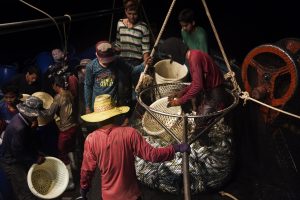
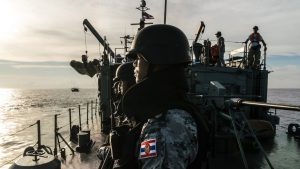
For the past four years, I’ve conducted an investigation with an international team of reporters at sea and on land that revealed a broad pattern of severe human rights abuses tied to the global seafood industry. We focused on China because it has by far the largest high-seas fishing fleet and processes much of the world’s catch. China estimates that it has 2,700 distant-water fishing ships, though this figure does not include vessels in contested waters; public records and satellite imaging suggest that the fleet may be closer to 6,500 ships. The U.S. and the E.U., by contrast, have fewer than 300 distant-water fishing vessels each.
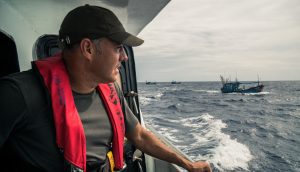
This story was produced by The Outlaw Ocean Project, a nonprofit journalism organisation in Washington, D.C. Reporting and writing was contributed by Daniel Murphy, Joe Galvin, Maya Martin, Susan Ryan, Austin Brush, and Jake Conley. The investigation documented cases of debt bondage, wage withholding, excessive working hours, beatings of deckhands, passport confiscation, the denial of timely access to medical care, and deaths from violence. Data from just one port – Montevideo, Uruguay – showed that for much of the past decade, one dead body has been disembarked there roughly every month and a half, mostly from Chinese fishing ships. Journalists, especially from the West, are rarely permitted aboard Chinese ships. To get a glimpse into this world, my team and I visited China’s fishing ships in their largest fishing grounds: near the Galapagos and Falkland Islands, off the Coast of Gambia, and in the Sea of Japan, near Korea. Occasionally, Chinese captains permitted me to board their vessels to talk to crew, or to interview officers by radio. In many cases, the ships got spooked, pulling up their gear and fleeing the scene. After this happened, we trailed the ships in a skiff to get close enough to throw aboard plastic bottles weighed down with rice and containing a pen, cigarettes, hard candy, and interview questions.
On several occasions, the deckhands quickly wrote their replies, often providing phone numbers for family back home, and then tossed the bottles back into the water. After returning to shore in foreign ports, we contacted families of the workers and interviewed several dozen additional former and current crew.
Getting onto these ships was essential not just to hear from the crew, including some that said they were being held against their will, but also to experience first-hand the conditions on board. Many deckhands spend over two years at sea without touching land or communicating with their families, and they work long shifts that often last more than 12 hours. Some contract beriberi, a disease caused by deficiencies in vitamin B1, also known as thiamine, and often induced by diets consisting mainly of foods which are low in this vitamin. The disease, fatal if left untreated, has largely been stamped out. Experts say that when it occurs at sea, beriberi often indicates criminal neglect because it is so easily treatable.
We also investigated labour concerns within China’s factories, where large amounts of the world’s seafood gets processed, including catch coming from European and U.S. ships and waters. Over the past decade, China has overseen a crackdown on Uyghurs and other ethnic minorities in Xinjiang, a region in the far west of the country, setting up mass detention centres and forcing detainees to work in cotton fields, tomato farms, and polysilicon factories. But, as it turns out, we found that state-sponsored forced labour from Xinjiang is also being used extensively in the country’s seafood factories that supply hundreds of restaurants, grocers, and food-service companies in the U.S., Europe, and elsewhere.
Our team reviewed hundreds of pages of internal company newsletters, local news reports, a database of Uyghur testimonies, trade data, and satellite and cell phone imagery to verify the location of processing plants. We also hired investigators in China to discreetly visit several plants using Uyghur workers.
To maximise the impact, we worked to connect the supply-chain dots from the abuses at sea or in the Chinese factories to the global brands, buyers, and sellers of this seafood. This is distinctly difficult with seafood because in the many handoffs of catch between fishing boats, carrier ships, processing plants and exporters, there are gaping holes in traceability. We relied heavily on satellite tools to track ships and to identify illegal or suspicious behaviour and hired investigators in China to covertly follow trucks carrying seafood from Shidao port to factories. Trade data then allowed us to track exports from processing plants to stores and restaurants abroad.
We wanted to empower the public in their shopping decisions, force industry and government to confront the extent of the problem and engage in a higher order of transparency. To accomplish both of those goals, we created a series of tools on our website to publicly share every exchange we had with every stakeholder so reporters, advocates and industry players can see who said what. Another tool graphically represents the supply chain of seafood from ships and processing plants to downstream brands and consumers, connecting the crimes on vessels and at processing facilities to store shelves so that Western consumers can see how they are tied to these otherwise far-away concerns.
Only by publicly identifying the beneficiaries of these crimes, might companies and governments feel pressure to fix these problems.
More of Ian's columns
Only by publicly identifying the beneficiaries of these crimes, might companies and governments feel pressure to fix these problems.
Continue reading
This story is exclusively for Oceanographic subscribers.
