Cal Major is a vet, ocean advocate and world-record stand up paddleboard adventurer who founded the UK charity Seaful to reconnect people to the ocean. In this column, she explains how she embraced the wildest swim of her life recently.
More of Cal's columns
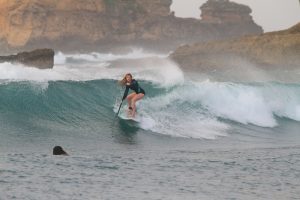

The wind had arrived again overnight and felt like daggers on my bare legs as I wandered towards the shore, the air and water full of energy. Then came the delicious first bite of cold water as I waded into the stormy ocean.
Some people get upset with the term ‘wild swimming’. Perhaps since cold-water and outdoor swimming have become more popular, and the term more ‘trendy’. I’ve heard people say, “it’s not ‘wild swimming’, it’s just ‘swimming’!”
Well, I say call it what you like! We all need more wildness in our lives. And if getting into a freezing body of water makes someone feel wild, if being part of a culture or a community of ‘Wild Swimmers’ gets someone outside and connecting with their own inherent, and our planet’s, wildness more, I consider the name a good fit.
I had the wildest swim of my life this weekend. I have been craving a long sandy beach and the spaciousness of the horizon. I’ve been craving surf, and had been planning a trip to the Outer Hebrides, an island chain off the North West coast of Scotland which just so happens to be one of my closest surf spots, with my partner James, to get my fix of both. After weeks of checking the surf, wind and weather forecasts, and weeks of named storms, I finally saw our opportunity.
I was so excited. I had planned which beaches we’d go to. My extra thick winter wetsuit and surfboard were ready. This was it. It was forecast to be minus 4, but the waves looked very promising. And then the ferry was cancelled because of strong winds, leaving a void in our plans. I checked the mainland’s West, North and East coasts, and the next nearest surfable beach was a three- hour drive away.
Well… there was one beach where there’d be waves. And it was much closer to home… Sandwood Bay. Britain’s remotest beach – a long sandy wilderness. Just over an hour drive from home, but a subsequent five- mile hike in.
It was either drive for three hours or hike it. Eager for an adventure, I decided upon the latter. My original plan was to take a wetsuit and a handplane, and bodysurf. But I wanted to capitalise on this opportunity for wildness, and camp out. Once I’d packed all my overnight gear, there wasn’t room for a wetsuit or a hand plane. I’d just have to play in the waves in the purest, wildest form – nothing between my body and the ocean.
During the hike in I was full of anticipation. I’d wanted to visit this beach for years, longed to spend the night here. I hadn’t imagined that the first time would be during a cold snap in February! Hiking past snowy mountains, it added to the suspense and sense of adventure. After a couple of hours of heathland, the view suddenly opened up to reveal the dunes ahead of us. My heart rate spiked as I saw Cape Wrath in the distance – the UK’s most Northwesterly point, and a fearsome headland which I had paddleboarded around whilst circumnavigating Scotland in 2021 – a humbling, exposed and wild place of enormous tides and sheer cliffs that filled me with deep respect and fear.
We arrived at the magnificent, lunar dunes, sculpted by uninterrupted Atlantic winds, barely a footprint visible. Even fewer when we arrived on the beach – we were the only people there. I felt my entire being relax, felt a sense of being a wild soul on that wild beach. Just James and I and the gulls. We set up our tent, and while James photographed an impossible looking rock stack in the dramatic evening light, I wandered up and down the perfect sand, simultaneously not wanting to spoil it with my footprints and feeling like I belonged there.
I filled a bag with plastic – mostly bits of fishing rope. There was way more than we could carry out – huge tangles of ropes and buoys which we will go back for one day. The colourful pieces along the strand line were the only other sign of human existence.
Everything was simple, connected, real. We made dinner and then spent hours half in and half out of the tent watching the stars, silent except for the occasional joke or remark. When it was time to get into the tent, wrapped in all our layers, we read our respective books by head torch (James’ about mountains, mine about whales) and slept well, waking occasionally to the sound of rain, rising in the morning to the roar of the ocean.
It all sounds very idyllic, and it was. Writing about it now I am smiling at its beautiful, wild simplicity. There was just one more thing to do before hiking back out – get in the sea. It was cold. I hadn’t removed my two down jackets or down trousers since arriving the afternoon before. The wind had arrived again overnight and felt like daggers on my bare legs as I wandered towards the shore, the air and water full of energy. Then came the delicious first bite of cold water as I waded into the stormy ocean – its waves by no means perfect for surfing, but glorious for a very wild swim.
More of Cal's columns
The wind had arrived again overnight and felt like daggers on my bare legs as I wandered towards the shore, the air and water full of energy. Then came the delicious first bite of cold water as I waded into the stormy ocean.
Continue reading
This story is exclusively for Oceanographic subscribers.
